

MATRIKA YOGA METHOD ®
“Over 20 years of research in Yoga, Ayurveda, Ancestral Wisdom, and Psycho-Spiritual Growth.”
Our Teaching
A Path of Self-Discovery and Psycho-Spiritual Growth
At Matrika Yoga, we teach from lived experience, in-depth study, and the conscious integration of different traditions.
Our methodology brings together both traditional and contemporary perspectives on yoga, Ayurveda, Eastern philosophies, and a range of therapeutic disciplines.
We do not seek to blend traditions indiscriminately. Instead, we present each method clearly and honour its foundations, so that every student can develop their own sādhanā: a personal path of practice, self-knowledge, and transformation.
This vision is present throughout our classes, retreats, teacher trainings, and intensive workshops held in Spain, India, and Latin America.
Practice and Tradition
Different Paths of Yoga
01 — Iyengar Yoga
A method developed by B. K. S. Iyengar, based on precision, postural alignment, and the conscious use of props.
Its study encompasses both physical and energetic anatomy, making it possible to adapt the practice to each person’s individual characteristics. Its therapeutic dimension makes it an accessible, profound, and transformative system.
02 — Traditional Hatha Yoga
Inspired by the teachings of the Bihar School of Yoga, it integrates āsana, prāṇāyāma, meditation, and traditional purification techniques.
Its practice aims to harmonise body, mind, and energy, balancing the solar and lunar qualities present within each person.
03 — Kriya Yoga
Kriya Yoga forms a bridge between Hatha Yoga and Tantra Yoga practices.
It employs breathing, concentration, and purification techniques to work with the energy centres, the chakras, and the marma points, supporting deeper states of consciousness.
04 — Classical Tantra Yoga
Based on the traditional scriptures and practices of Tantra, this path deepens the integration of body, mind, energy, and consciousness.
Meditation and techniques for expanding perception allow practitioners to move towards a direct experience of the Self.
Philosophy and Contemplation
Worldviews That Guide the Practice
01 — Kashmir Shaivism
This tradition, also known as non-dual Kashmir Tantra, offers a path of presence, embodied awareness, and recognition of the essential nature of the Self.
It invites us to experience reality without separation and to integrate the sacred into every dimension of everyday life.
Our school draws inspiration from the teachings of Swami Lakshmanjoo and from the work of teachers and scholars such as Amit Raina, Christian Pisano, Bettina Bäumer, and Mark Dyczkowski.
02 — Tibetan Mahayana Buddhism
This tradition offers a contemplative perspective centred on meditation, compassion, self-transcendence, and the cultivation of wisdom.
We draw upon the teachings of masters such as Lama Yeshe and Geshe Dorgi, as well as the practice developed at centres including Tushita Meditation Centre in Dharamsala and Kopan Monastery in Nepal.
An Integral Vision
Yoga, Health, and Transformation
We understand yoga as an integral path of knowledge, balance, and personal transformation.
We complement yogic teaching with principles drawn from Ayurveda, osteopathy, and psychology, adapting the practice to the needs and circumstances of each person.
-
Ayurveda: a traditional system of health that seeks to balance body, mind, and energy through nutrition, daily routines, herbal medicine, and purification practices.
-
Individual constitution: Ayurveda recognises each person’s unique nature through the doṣas of Vata, Pitta, and Kapha.
-
Osteopathy: a therapeutic approach that understands the body as a functional whole, in which structure and function are interconnected.
-
Therapeutic integration: the aim is to support balance, the body’s capacity for self-regulation, and a more conscious relationship with one’s own organism.
WHAT DOES MATRIKA MEANS?
Origin and Meaning
The Meaning of Matrika
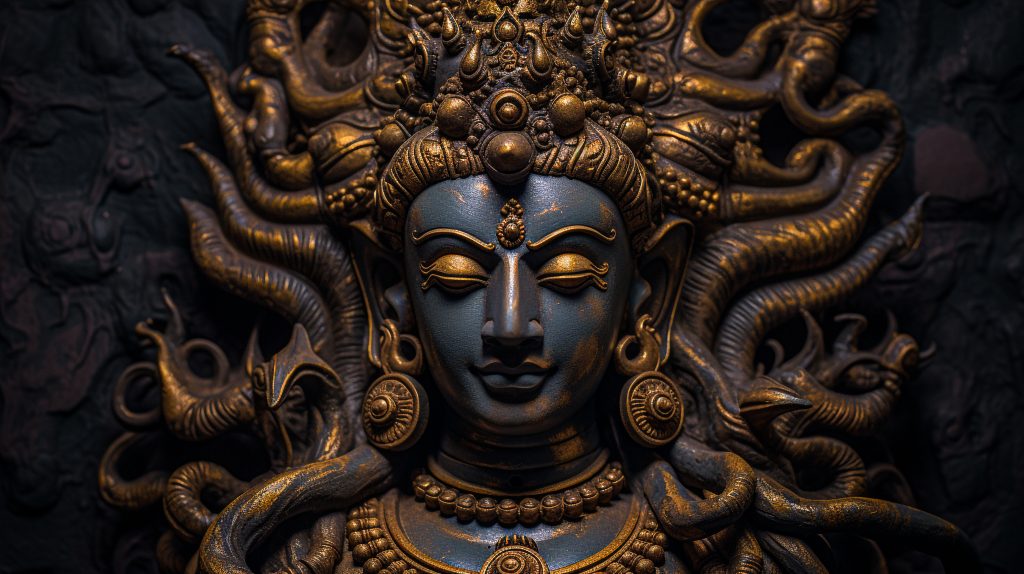
Matrika is a word of Sanskrit origin meaning “mother” or “divine mother.”
In Hinduism, the Matrikas are a group of mother goddesses who are represented together. Depending on the tradition consulted, they may be seven, known as the Saptamatrikas, or eight, known as the Ashtamatrikas.
Hindu texts offer different accounts of their origin:
-
In Shaivism: Shiva creates the Matrikas to help him defeat the demon Andhaka.
-
In other traditions: Brahma creates them to overcome the demon Nirrita.
-
In other accounts: the Matrikas arise from the mind of the goddess Vaishnavi and take part in the struggle against demonic forces.
The Matrikas simultaneously represent creation and destruction, expressing the transformative power of the feminine in its divine dimension.
Sanskrit Tradition
Other Meanings of Matrika
Beyond its mythological dimension, the word Matrika takes on other meanings within yoga and the Tantric tradition.
01 — The Subtle Energy of Sound
In Tantra and yogic philosophy, Matrika refers to the letters of the Sanskrit alphabet, understood as sonic seeds imbued with vibrational energy.
Before manifesting as words, these energies are said to exist in a subtle form capable of influencing consciousness.
02 — Matrika and Mantras
In the Tantric tradition, the Matrikas are associated with bīja mantras, or seed sounds, which are used to transform the practitioner’s mind and energy.
03 — Model, Measure, and Matrix
In Sanskrit, Matrika can also mean model, pattern, or matrix: an organising principle present in the structure of creation.
Reflection
Sound, Consciousness, and Creation
The word Matrika contains multiple layers of meaning: divine mother, primordial vibration, language, and creative principle.
Its symbolism invites us to observe how sound, speech, and consciousness participate in the way we interpret and transform reality.
“Whatever your position may be, remain there without moving either inward or outward. Then, through the radiance of your own consciousness, observe the manifold diversities of your future.”
— Jayaratha, Tantrāloka-viveka
“Giving does not impoverish us, nor does holding back make us richer.”
“Without having attained perfection in āsana, energy cannot flow.”
— B. K. S. Iyengar

Sign Up to our Newsletter
Data Protection
Your rights: You may withdraw your consent at any time. You may also exercise your rights to access, rectify, or erase your personal data, as well as any other applicable rights, by contacting us at namaskarmatrikayoga@gmail.com.
Additional information: You can find further information in our Legal Notices.